
Pedagogies, Curation, and Engagement in Chinese Religious Art
- Sawyer Baker
- Mar 20
- 2 min read

Some of the sessions that I attended at the Association for Asian Studies Conference covered innovative teaching models, curatorial strategies, challenges of technology, and the importance of context, resonance, and ethical awareness.
Three-Stage Pedagogical Model (Material Culture in Buddhist Studies)
Stage 1: Material Analysis Essay
Students select a Buddhist object/site from digital collections or databases.
Tasks: Close observation, contextual analysis, religious function, and historical significance.
Stage 2: Research Proposal—Narratives of Buddhist Lives
Students imagine the lived experiences of historical Buddhist practitioners.
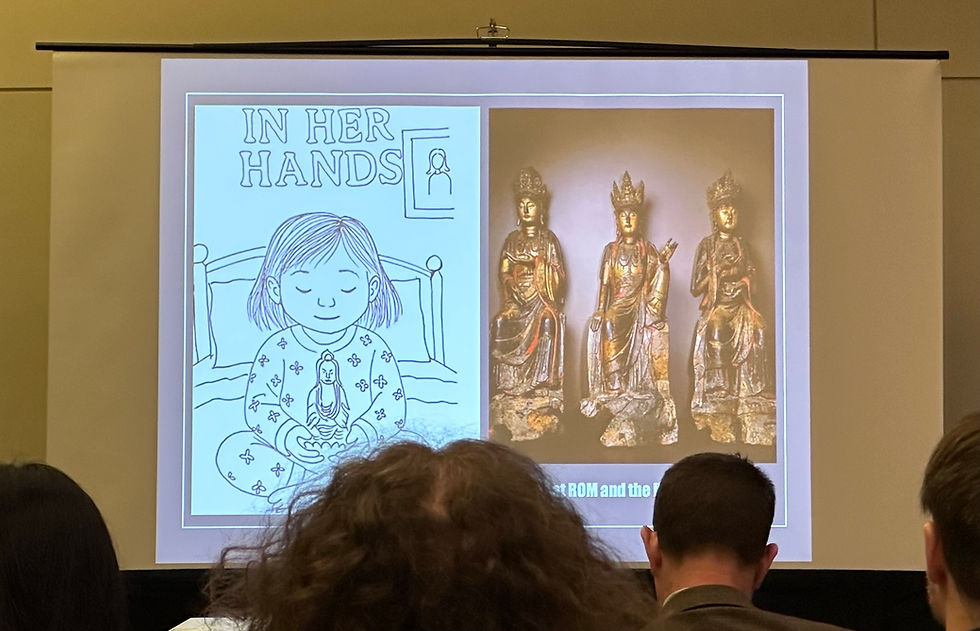
Encouraged to use creative forms (fiction, poetry, illustration).
Stage 3: Live Narrative Research Paper
Reconstructs the religious and social world surrounding the chosen object.
Emphasizes material culture as a gateway to Buddhist practice and community.
Example Assignments:
A student reimaged the story of Empress Dowager Hu and her Buddhist pagoda. This was a creative way to bring this history to modern day and engage the youth in learning about Buddhism.
Technological Integration: Opportunities & Challenges
Benefits:
3D modeling, digital reconstructions, virtual museum tours broaden access.
Online collections enable engagement when physical resources are limited.
Challenges:
Technological inequality—uneven access to advanced tools.
Spectacle vs. substance—risk of reducing religious significance to visual entertainment.
Fragmentary evidence—digital models can create false certainty.
High cost and resource demands for advanced tech projects.
Interpretive Strategies: Resonance vs. Wonder
Wonder: Focus on visual uniqueness and exoticism, often at the expense of context.
Resonance: Emphasizes relational, contextual, and cultural processes; seeks to evoke a deeper, dynamic understanding.
Layered Interpretation: Content (what is presented) and context (world surrounding the object) must both be addressed.
Ethical, Social, and Temporal Considerations
Transparency: Clearly state interpretive positions (insider/devotional vs. outsider/analytical).
Ethical Awareness: Acknowledge colonial histories and the limits of reconstruction.
Temporal Depth: Recognize the challenges of conveying time and ritual duration in museum and classroom settings.
Audience Engagement
Strategies:
Use of sensory experiences (lighting, sound, scent) for immersive engagement.
Participatory methods: co-creation of narratives, community involvement.
Online and analog resources to overcome institutional limitations.
Challenges & Limitations
Resource Constraints: Not all institutions have access to tech or extensive collections.
Risk of Oversimplification: Visual spectacle may overshadow deeper meanings.
Fragmentary Evidence: Archaeological and digital reconstructions are always partial.
Time Constraints: Limited engagement time in museums; need for strategies to deepen encounters.

My reflection and thoughts:
It was very interesting to learn about the above. I appreciate the use of technology while also understanding it's limitations and challenges. Today's students may want a class that is a refuge away from technology and allow a greater exploration of history and art to connect in deeper way. Students are on their laptops and phones numerous hours of the day. I think an immersive experience is most meaningful to gain an understanding through this influential learning process and make a spiritual and emotional connection.


Comments