
Chinese Cultural Practices-President Trump's Visit to China

Several traditional Chinese cultural practices and symbols were highlighted during President Trump’s 2026 visit to China. The visit was designed not only as a diplomatic meeting but also as a showcase of Chinese history, philosophy, and ceremonial traditions.
1. Visit to the Temple of Heaven
Trump and Chinese President Xi Jinping visited the Temple of Heaven, one of China’s most important historical and religious sites. During the Ming and Qing dynasties, emperors traveled there to pray for good harvests and perform ceremonies honoring Heaven. The site symbolizes the traditional Chinese belief that rulers governed under the “Mandate of Heaven.”

2. Traditional State Ceremony
China welcomed Trump with a formal state reception that included:
Military honor guards
National anthems
A 21-gun salute
Children waving Chinese and American flags
Elaborate diplomatic protocol
These ceremonies reflect China’s emphasis on ritual, respect, and state symbolism.

3. Chinese Philosophy and Cosmology
While visiting the Temple of Heaven, Xi reportedly explained the ancient Chinese concept of “Heaven is round, Earth is square” (Tian Yuan Di Fang), which reflects traditional Chinese views about the universe, harmony, and humanity’s place within it.
4. Banquet Traditions
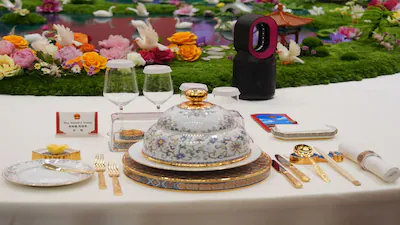
A formal state banquet was held in the Great Hall of the People, continuing China’s long tradition of using ceremonial meals to honor foreign leaders and build diplomatic relationships. Banquets are an important part of Chinese hospitality and diplomacy.
5. Historical and Cultural Symbolism
Chinese hosts used important cultural landmarks and traditions to emphasize China’s long history and civilization. Commentators noted that the visit highlighted Chinese heritage through architecture, ceremonial settings, and references to imperial traditions.
Comparison to Trump’s 2017 China Visit
In Trump’s 2017 visit, China showcased additional cultural traditions, including:
A tour of the Forbidden City
Traditional tea service inside the palace
A performance of Peking Opera, combining music, dance, acrobatics, and storytelling
Displays of ancient Chinese musical instruments such as bronze chime bells (bianzhong)

Peking opera is a performance art incorporating singing, reciting, acting, martial arts. Although widely practised throughout China, its performance centres on Beijing, Tianjin and Shanghai. Peking opera is sung and recited using primarily Beijing dialect, and its librettos are composed according to a strict set of rules that prize form and rhyme. They tell stories of history, politics, society and daily life and aspire to inform as they entertain.
The cultural message of the 2026 visit was to present China as an ancient civilization with deep traditions, while using historical sites, ceremonies, and hospitality to reinforce diplomatic ties.


Comments